

Running Gait Analysis | Injury Assessment & Coaching in Brooklyn
Injury Prevention, Return-to-Running Strategy & Coaching for Road, Trail & Ultramarathon Athletes
If you are searching for running gait analysis in Brooklyn, you may be dealing with recurring injuries, performance plateaus, inefficient stride mechanics, or uncertainty about how to safely progress your training.
At Form & Function Chiropractic, running assessment goes beyond visual observation. We combine clinical expertise, biomechanical technology, and structured coaching principles to help runners understand how their body moves — and how to improve it.
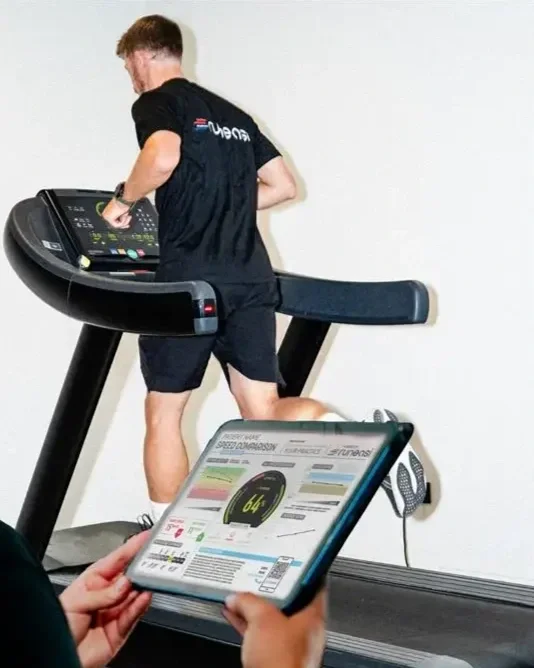
Care begins with precise evaluation of mobility, strength, tendon load tolerance, and movement control. When appropriate, advanced biomechanical analysis using Runeasi motion assessment technology is incorporated to provide objective insight into running mechanics and injury risk.
What Is Running Gait Analysis?
Running gait analysis evaluates how forces are absorbed, transmitted, and controlled through the body during running.
Unlike traditional treadmill observation alone, modern wearable biomechanical systems can measure:
impact loading and cumulative mechanical stress
dynamic stability and movement control
left-right asymmetry and compensation patterns
fatigue-related changes in running form
stride timing and efficiency
These objective insights help guide individualized return-to-running plans, performance development strategies, and injury prevention frameworks.
Advanced sensor technology positioned near the body’s center of mass allows clinicians to analyze movement patterns in real time and generate actionable training recommendations.
Our Performance & Injury Assessment Approach
Running evaluation at Form & Function Chiropractic integrates:
Clinical Movement Assessment
joint mobility and tissue extensibility
tendon load tolerance
neuromuscular control
strength and stability testing
Biomechanical Running Analysis
Using wearable sensor technology, we evaluate:
impact force transmission
pelvic and trunk stability
gait symmetry
cadence and stride characteristics
fatigue-related movement changes
Machine-learning algorithms can process high-frequency motion data to detect gait events and loading patterns that may not be visible during standard observation.
Data-Driven Coaching Strategy
Findings are translated into:
individualized cueing strategies
strength and plyometric progression
cadence or stride modification
terrain and volume management
safe return-to-running timelines
Objective metrics can also be tracked over time to measure improvement and guide progression decisions.
Runeasi Analysis Reports
-
![A Runeski session report showing a duration of 31 minutes and 40 seconds, with a score of 74% marked as great. The report evaluates impact loading, dynamic stability, and symmetry with respective scores of 79% (great), 99% (outstanding), and 44% (fair). It includes training opportunities with maintenance recommendations for impact loading, dynamic stability, and symmetry, and features a QR code and branding for Runeski.]()
Runeasi Session Report 1/3
-
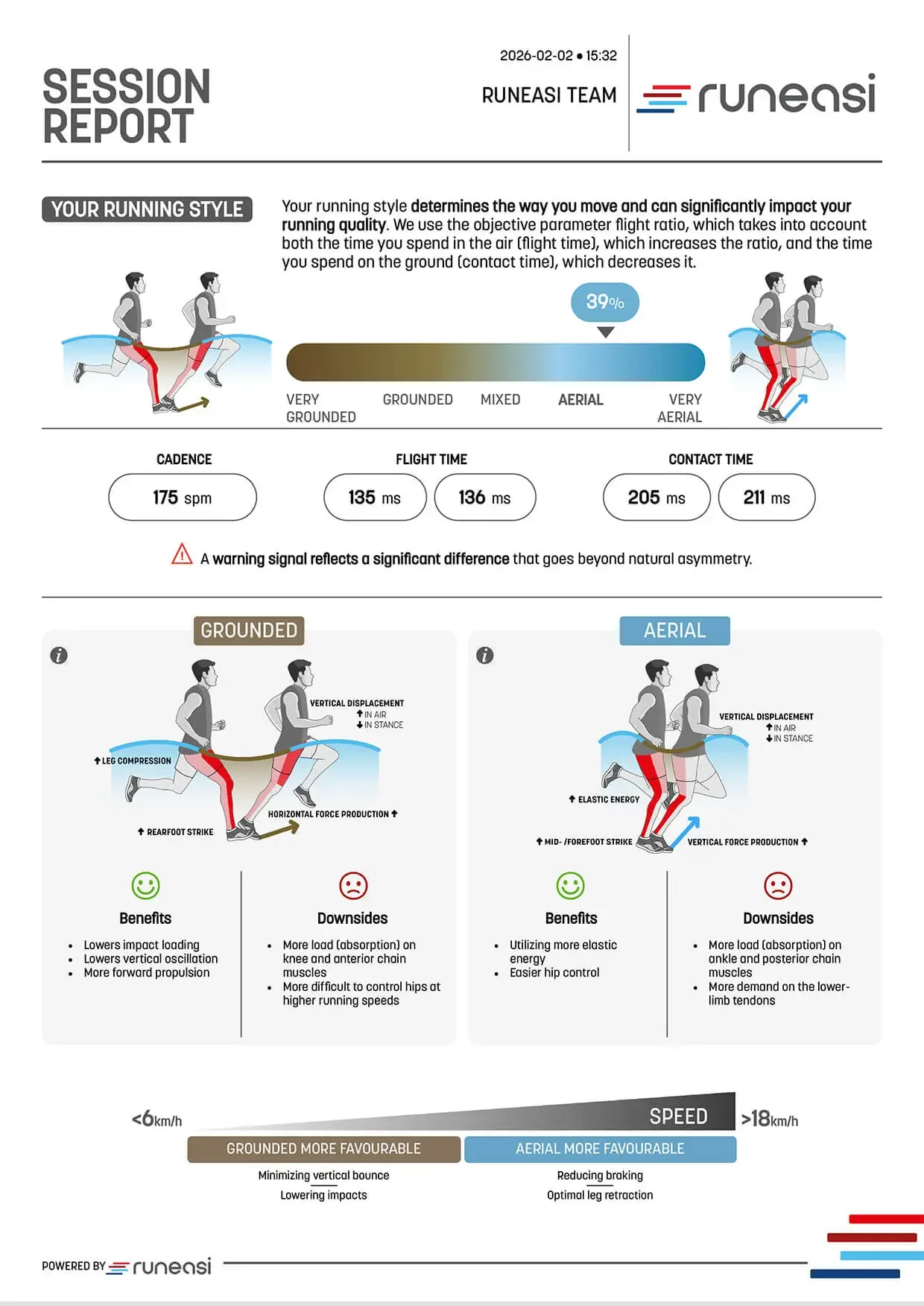
![A session report graphic analyzing running styles, comparing grounded versus aerial running, including statistics on cadence, flight time, contact time, and benefits and downsides of each style.]()
Runeasi Session Report 2/3
-
![A detailed sports session report from RUNEASI TEAM, dated February 2, 2026, showing metrics on impact loading, dynamic stability, and symmetry, with color-coded graphs and analysis of impact magnitude, impact duration, stability, and symmetry to evaluate athletic performance.]()
Runeasi Session Report 3/3
-
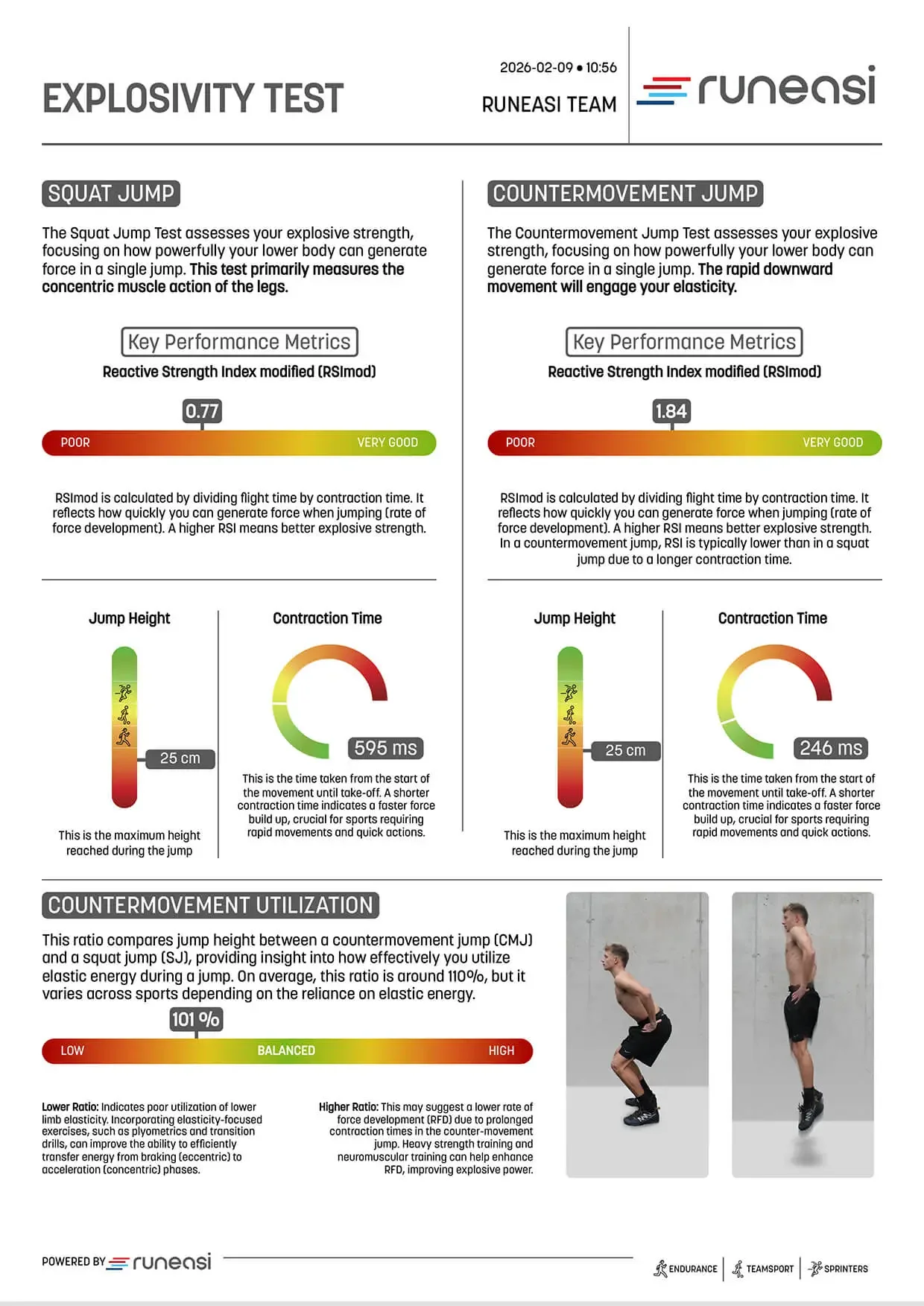
![Explosivity test report comparing squat jump and countermovement jump, with measurements of RSI modification, jump height, and contraction time, including images of a man preparing to jump.]()
Explosivity Test
-
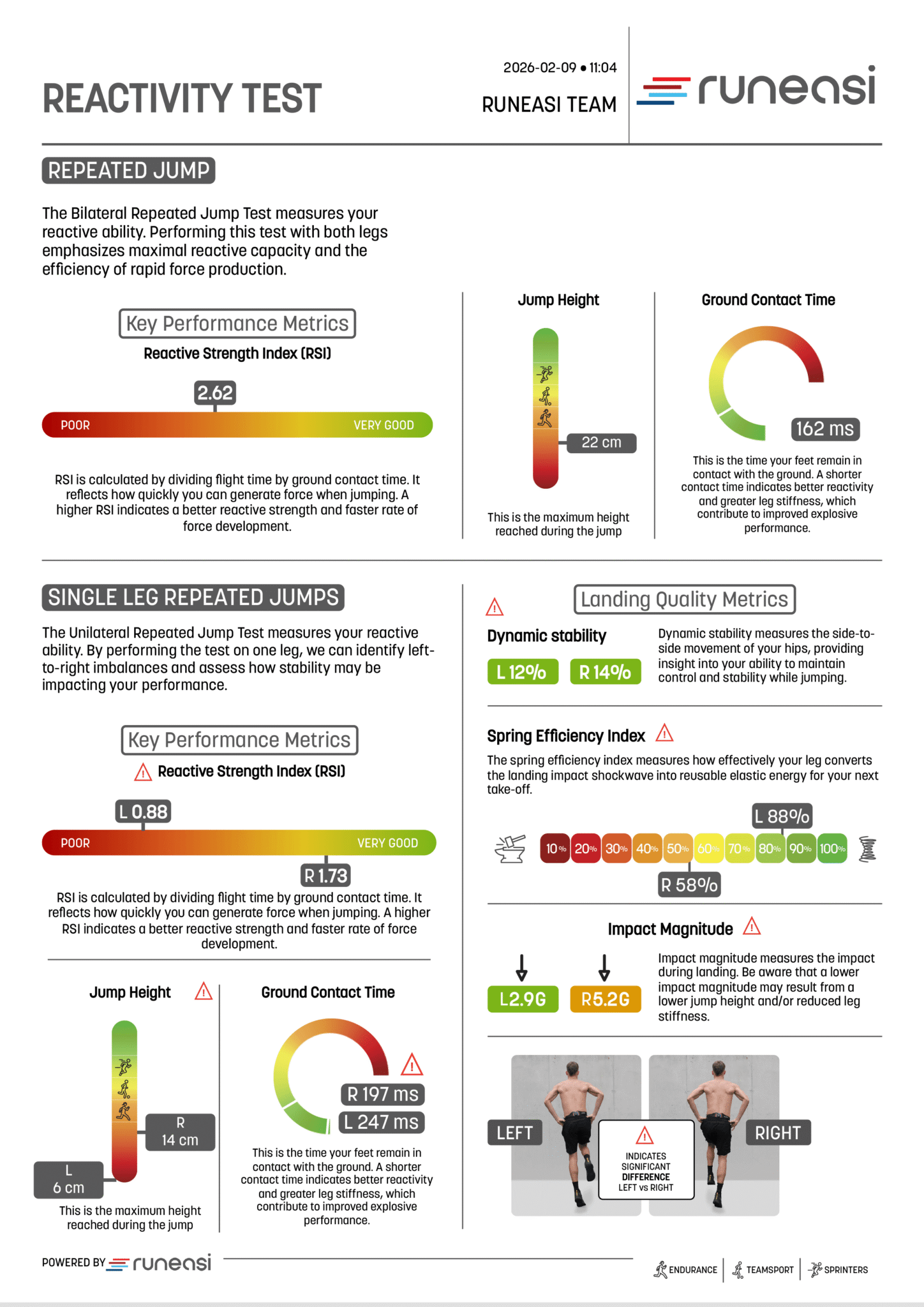
![A detailed report on a reactivity test for jump performance, including metrics like reactive strength index, jump height, ground contact time, and landing quality metrics for single leg jumps, displayed with various gauges and diagrams.]()
Reactivity Test


Why Running Mechanics Matter
Many common running injuries are not caused by a single event — they develop from repeated loading that exceeds tissue capacity.
Examples include:
Who Benefits From Running Assessment?
Running gait analysis may be appropriate for:
runners with recurring injuries
athletes returning after time off
performance plateau or inefficiency concerns
transition to higher mileage or race distance
preparation for marathon or ultramarathon
new runners seeking injury prevention guidance
Running gait analysis helps identify modifiable contributors to overload, allowing treatment to address root mechanical factors rather than symptoms alone.
Frequently Asked Questions
-
Running gait analysis evaluates how forces are absorbed, transmitted, and controlled through the body during running. It can help identify loading patterns, asymmetry, dynamic stability issues, and stride characteristics that may influence injury risk and performance
-
When combined with strength development and structured load management, modifying cadence, stride pattern, or impact control strategies may help reduce excessive tissue stress and recurrent injury patterns.
-
Yes. Many overuse injuries are influenced by stride mechanics, cadence, ground contact forces, and tissue load tolerance. Assessment helps identify modifiable contributors to overload.
-
Yes. New runners may benefit from early guidance on cadence, training progression, and tissue load tolerance to reduce injury risk.
-
Yes. Improving movement efficiency, stability, and load distribution may help runners tolerate higher training volumes and maintain pace with less fatigue.
-
Yes. Retail gait assessments often focus on footwear selection. Clinical running analysis integrates injury history, tissue capacity, strength, mobility, and rehabilitation planning.
-
Assessment time varies based on the depth of evaluation needed. Some runners require targeted analysis of specific symptoms or performance concerns, while others benefit from a more comprehensive assessment including clinical testing, biomechanical data review, and training progression planning.
Evaluation duration is determined by the level of detail necessary to guide precise rehabilitation and performance strategies—(15 minutes to an hour).
-
Running gait analysis is often repeated periodically to monitor biomechanical improvement, assess tissue load tolerance, and guide safe training progression.
Reassessment may be useful:
during rehabilitation or return-to-running phases
after strength or mobility improvements
when increasing weekly mileage or training intensity
when preparing for longer race distances
as part of long-term performance development
Objective reassessment helps track adaptation over time and refine coaching and rehabilitation strategies.
-
Running assessments are offered at different levels depending on the depth of evaluation required.
Focused running gait evaluations typically begin at $99.
For runners seeking more advanced performance insight, explosivity testing (such as squat jump and countermovement jump) and reactivity testing (including bilateral and unilateral hopping assessments) can be added. These objective performance measures can be completed in just a few minutes and are available for an additional $49, bringing the total for an expanded assessment to $149.
Additional services such as running-specific strength or durability programming may be recommended based on assessment findings and performance goals.
-
All running assessments include individualized recommendations to help guide training progression, injury risk reduction, and performance development.
Structured long-term running coaching is offered separately. For local runners participating in coaching programs, the initial biomechanical assessment is incorporated into the coaching onboarding process, and periodic reassessments may be included within advanced coaching tiers.

Get Started Today and Schedule a Running Assessment in Brooklyn
Form & Function Chiropractic
“Objective biomechanical insight combined with structured rehabilitation and endurance coaching can help you return to running safely — and perform at a higher level.” ~ Craig Patane, D.C., FRCms